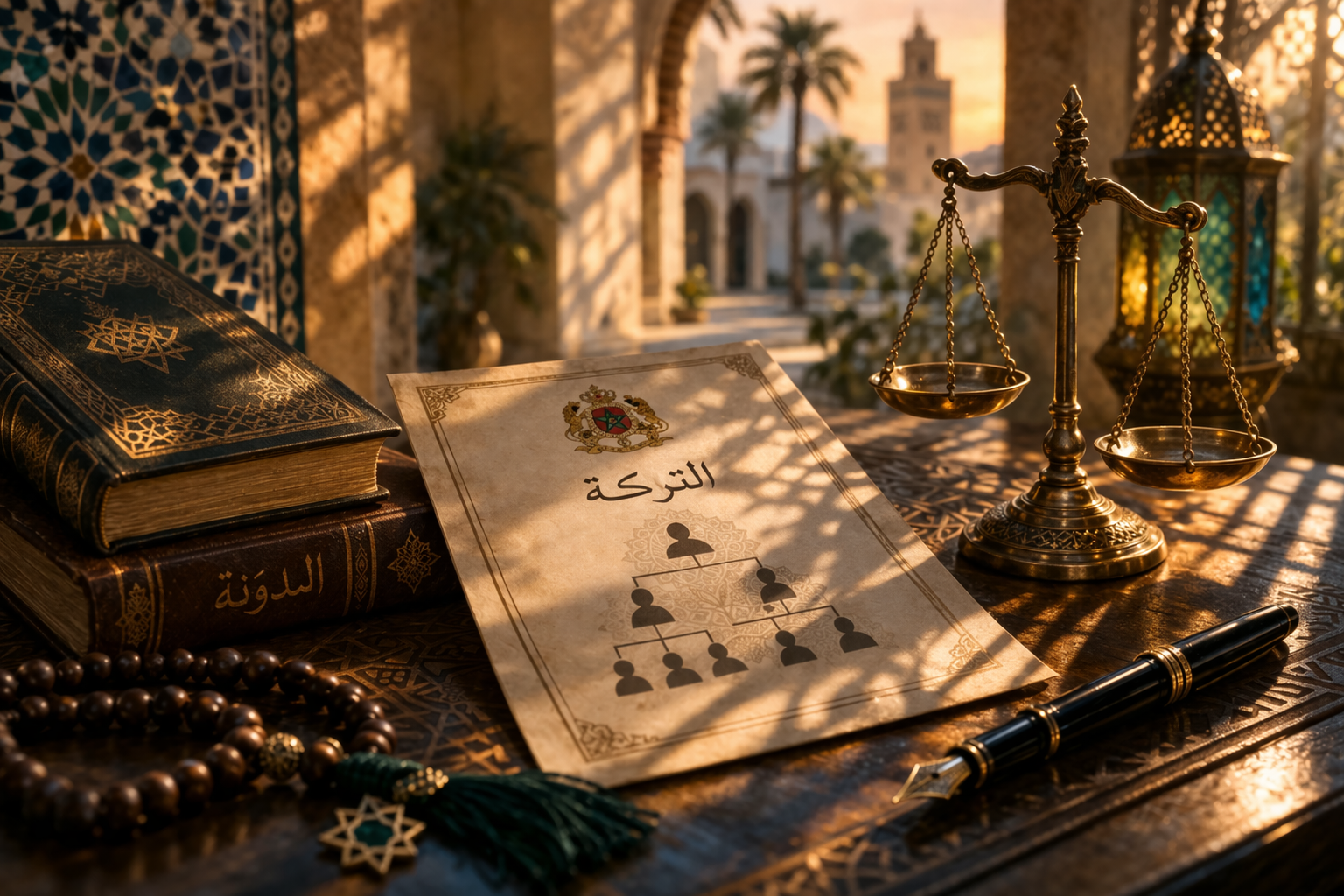
Succession law in Morocco is a complex legal field that combines principles of Islamic law with specific aspects of modernized Moroccan legislation. This article explores in detail the rules governing inheritance in Morocco, the different shares allocated to heirs according to their degree of kinship, as well as special cases and exceptions.
For informational purposes only. The information in this article is general in nature and does not constitute legal advice. For any specific situation, consult a qualified lawyer registered with the Moroccan Bar.
Legal Framework of Inheritance in Morocco
The Moroccan succession system is primarily governed by the reformed Family Code (Moudawana) of 2004, which incorporates both principles of Islamic law (fiqh) and modern legal developments.
The main legal sources that frame inheritance in Morocco are:
• Book V of the Family Code (Articles 321 to 397) • The Maliki school, the predominant Islamic legal school in Morocco • The jurisprudence of Moroccan courts on succession issues
This combination creates a hybrid system that respects religious foundations while adapting to contemporary social realities.
Fundamental Principles of Islamic Inheritance
Moroccan succession law is based on several essential principles:
• Automatic transmission: Inheritance is automatically transmitted to heirs from the moment of death, without need for acceptance • Priority of debts: Before any distribution, the deceased’s debts and funeral expenses must be settled • Respect for testamentary bequests: The deceased’s will (wasiya) is respected within the limit of one-third of the estate • Pre-established shares: The law precisely defines the shares allocated to each heir according to their kinship tie • Male/female distinction: In certain cases, the male heir’s share equals that of two female heirs of the same degree
Categories of Heirs and Their Shares
Moroccan law distinguishes several categories of heirs:
Reserved Heirs (Fardh)
These heirs benefit from a fixed share defined by law:
• The surviving spouse: 1/4 if there are descendants, 1/2 in the absence of descendants • The wife: 1/8 if there are descendants, 1/4 in the absence of descendants • The daughter: 1/2 if she is unique, 2/3 to share if there are several • The parents: 1/6 each • Uterine brothers and sisters: 1/6 if there is only one, 1/3 to share if there are several
Universal Heirs (Aceb)
They receive the remainder of the succession after attribution of fixed shares:
• Sons • Grandsons (in the absence of sons) • Father, grandfather • Brothers and their descendants • Paternal uncles and their descendants
Heirs by Substitution (Tanzil)
The 2004 reform introduced inheritance by substitution, allowing grandchildren to inherit their predeceased parent’s share.
Calculation and Distribution of Inheritance
The calculation of inheritance in Morocco follows a precise procedure:
• Establishment of the estate assets: Complete inventory of the deceased’s property • Deduction of charges: Funeral expenses, debts, execution of the will (within the limit of 1/3) • Identification of heirs: Determination of entitled parties according to their kinship • Calculation of shares: Attribution of legal fractions to each heir • Final distribution: Distribution of assets or their value according to shares
The complexity of the calculation often justifies recourse to a notary (adoul) or a specialized lawyer.
Special Cases and Exceptions
The Will (Wasiya)
The deceased can bequeath up to one-third of their assets to people who are not their legal heirs. This provision allows certain flexibility, particularly to favor close relations who are not heirs or charitable works.
The Obligatory Legacy (Tanzil)
Since 2004, grandchildren whose parent died before the grandparent can inherit the share that would have been attributed to their parent, within the limit of one-third of the succession.
Habous Property (Waqf)
Property constituted as Habous follows a special regime and is not part of the ordinary succession.
Inheritance of Non-Muslims
Non-Muslim Moroccans can choose not to be subject to Muslim succession rules and opt for another legal regime.
Modernization and Recent Developments
• The 2004 Moudawana reform introduced the obligatory legacy (tanzil) for grandchildren • The debate on succession equality between men and women continues • Court jurisprudence contributes to the progressive adaptation of law to contemporary social realities • The internationalization of family situations poses new challenges in terms of private international law
Practical Procedures for Settling a Succession
To settle a succession in Morocco, several steps are necessary:
• Obtain a death certificate from civil status services • Establish a heredity certificate (iratah) by two adouls who determine the legal heirs • Inventory the deceased’s estate (real estate, movable property, bank accounts) • Settle debts and funeral expenses as a priority • Execute the will if it exists, within the limit of one-third of the estate • Calculate the shares of each heir according to Islamic law rules • Transfer the assets to heirs or proceed with their sale for distribution
Succession Taxation in Morocco
• Registration fees: 1.5% of the value of real estate properties • Land conservation: 1% for registration in land books • Notary tax: Variable according to the nature and value of assets • Adoul fees: For establishing heredity and partition deeds
Morocco does not apply inheritance tax as such, but registration and transfer fees.
Conclusion
The Moroccan inheritance system offers a detailed legal framework that combines religious tradition and modernized adaptations. Its complexity often justifies recourse to legal professionals to ensure a distribution that complies with the law and is equitable among heirs. Recent developments, particularly the introduction of the obligatory legacy for grandchildren, testify to the system’s capacity to adapt to contemporary social realities, while preserving its essential foundations derived from Islamic law.
The information presented in this article is provided for informational purposes only and does not constitute legal advice. For any specific situation, consult a qualified lawyer registered with the Moroccan Bar.