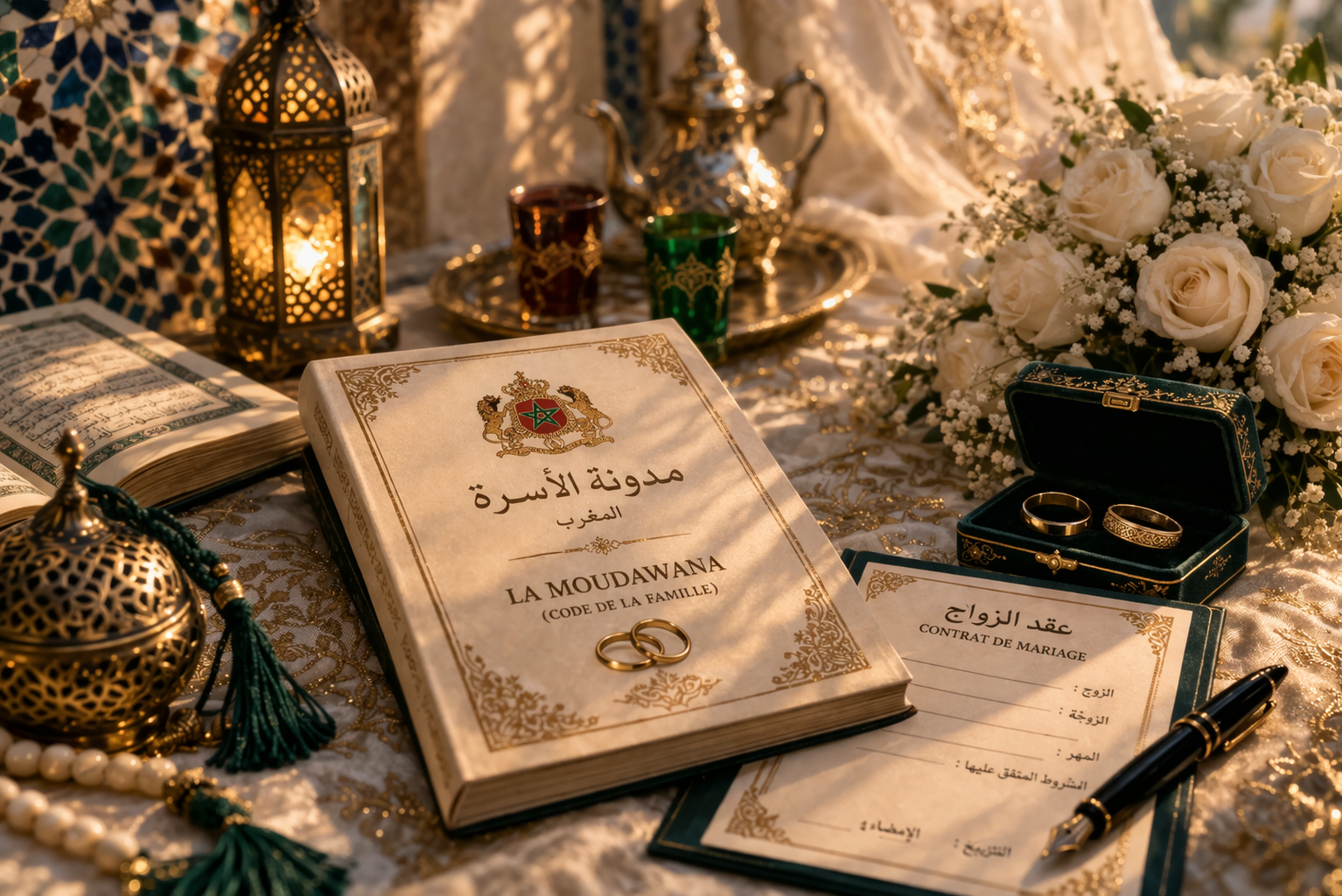
In Morocco, marriage is a legal and social institution governed by the Moudawana (Family Code). Whether you’re planning to marry or want to understand your rights, here’s what you need to know about marriage and marriage contracts in Morocco.
For informational purposes only. The information in this article is general in nature and does not constitute legal advice. For any specific situation, consult a qualified lawyer registered with the Moroccan Bar.
Legal Requirements for Marriage in Morocco
For a marriage to be valid in Morocco, several conditions must be met:
• Mutual consent: Both spouses must freely consent to marriage, without coercion • Legal age: 18 years old for both spouses (exceptions can be granted by a judge) • Presence of two Muslim witnesses (adouls) for Muslim Moroccans • Absence of legal impediments (prohibited family relationships, waiting periods not elapsed, etc.) • Establishment of an official marriage certificate (condition of validity since 2004)
The Marriage Contract: A Central Element
The marriage contract is not just a formality in Morocco, but a fundamental document that defines the rights and obligations of spouses:
Mandatory Elements of the Contract
• Complete identity of spouses • Dowry (sadaq): amount paid to the wife, which becomes her exclusive property • Marriage witnesses • Signatures of parties
Optional but Important Clauses
• Management of assets acquired during marriage (separatist regime by default) • Prohibition of polygamy (Article 40 of the Moudawana) • Right of the wife to pursue her studies or practice a profession • Conditions regarding the couple’s residence
The Dowry (Sadaq): Between Tradition and Law
The dowry (sadaq) is an essential element of Islamic and Moroccan marriage:
• Legal obligation: Mentioned in Article 26 of the Moudawana • Exclusive property of the wife: The husband has no right over the dowry • Flexible amount: No minimum or maximum amount set by law • Payment terms: Can be paid immediately or deferred
Rights and Duties of Spouses
The 2004 Moudawana significantly strengthened equality between spouses:
Common Rights and Duties (Article 51)
• Legal cohabitation and conjugal relations • Respect, affection and preservation of family interests • Shared responsibility in household management and children’s education • Consultation for decisions related to the family
Specific Protection for Women
• Legal equality with men (preamble of the Moudawana) • Right to add protective conditions in the marriage contract • Right to manage and freely dispose of her personal property • Protection against unilateral repudiation (replaced by judicial divorce) • Right to divorce for various causes (discord, lack of maintenance, redhibitory defect, etc.)
Management of Property During Marriage
By default, the matrimonial regime in Morocco is that of separation of property:
• Each spouse retains the exclusive ownership of assets acquired before and during the marriage • Each manages their assets freely without authorization from the other spouse
However, the 2004 reform introduced the possibility of opting for a regime of assets acquired in common during marriage (must be the subject of a document separate from the marriage contract, Article 49).
Issues of Mixed Marriages
For a Non-Muslim Wishing to Marry a Muslim Moroccan Woman
• Conversion to Islam generally required • Respect for the administrative procedures of both countries
For Marriages Celebrated Abroad
• Possible recognition in Morocco if they respect the formalities of the celebration country • Often necessary to transcribe the deed at the Moroccan consulate
In Case of Dissolution of Marriage
Types of Dissolution
• Divorce by mutual consent (Article 114) • Divorce for discord (chiqaq) - accessible to both spouses • Divorce for specific reasons (abandonment, lack of maintenance, etc.) • Divorce for compensation (khol)
Financial and Patrimonial Consequences
• Consolation gift (mout’a) due by the husband • Alimony (nafaqa) for children until their majority or end of studies • Division of property according to the chosen matrimonial regime • Child custody (hadana) generally attributed to the mother for young children
Conclusion
Marriage in Morocco falls within a precise legal framework which has undergone significant developments since the 2004 Moudawana reform. To ensure the legal validity of your union and the protection of your interests, consult a lawyer specialized in family law or a notary before committing.
The information presented in this article is provided for informational purposes only and does not constitute legal advice. For any specific situation, consult a qualified lawyer registered with the Moroccan Bar.